
Advacements in Alzeimher's Research
You may have heard of the term Alzheimer’s, but what you may not know is that it is the most common type of dementia and that around 55 million worldwide are affected by Alzheimer’s. Dementia is a broad term to describe mental decline, which includes symptoms like memory loss, language, and problem solving abilities that interfere with daily life. As of now there is no cure for Alzheimer’s. But this does not mean that you should lose hope. Advancements have been made in managing symptoms and hopefully for the progress of a cure. This post will outline them for you!
What is Alzheimer’s?
Alzheimer’s is a disease that results in decline in memory of thinking skills, to a point where a person cannot even perform simple tasks. It is caused by a buildup of proteins around brain cells. Scientists believe that it is caused by the amyloid protein which deposits plaques around brain cells and tau which forms tangles within brain cells. As this process continues, neurotransmitters which rely on messages between cells also decrease. Over time, areas of the brain began to shrink, with the first to go usually being the areas responsible for memory. There are risk factors associated with Alzheimer’s with the most prominent being: age, genetics, and health and lifestyle factors. Age is known as the biggest risk factor to Alzheimer’s, with less than 10% Alzheimer cases occurring in individuals less than 65 years old. Alzheimer’s does not have a single genetic cause, rather it is caused by a plethora of genetic variants. A genetic variant that increases the risk of Alzheimer’s is the apolipoprotein E (APOE) gene. This gene is believed to aid in making a protein that helps move cholesterol and other types of fat in the bloodstream. Scientists believe that issues in this process may contribute to developing Alzheimer’s. Furthermore, variations in the Amyloid precursor protein (APP) on chromosome 21,Presenilin 1 (PSEN1) on chromosome 14, and Presenilin 2 (PSEN2) on chromosome are believed to cause Alzheimer’s. If a parent has a genetic variant for one of these three genes, their child has a 50/50 chance of inheriting a changed version of that gene. Research also suggests that there is an association between cognitive decline and vascular diseases like heart disease, stroke, and high blood pressure. Other conditions found to correlate with Alzheimer’s include hearing loss
depression, mild cognitive impairment, or concussion or other traumatic brain injury.
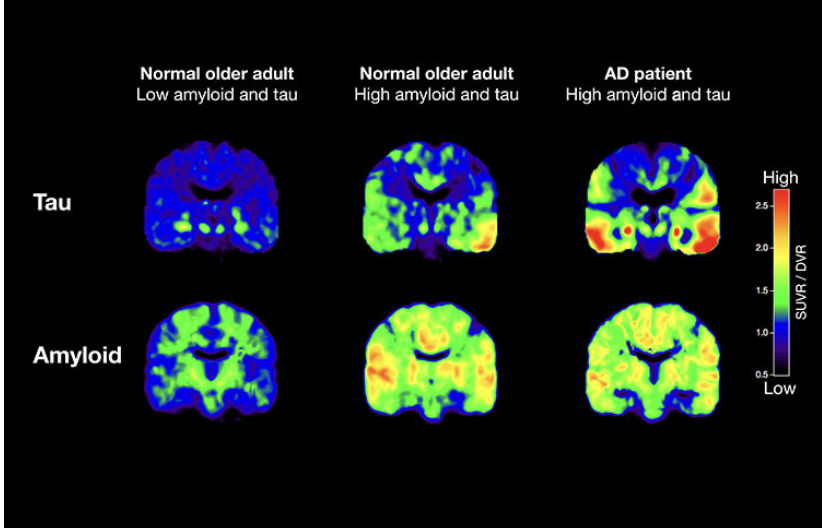
Here is a PET scan illustrating the increase in Tau and Amyloid in a patient with Alzheimer’s Disease (AD).
Recent Developments:
After reading what Alzheimer’s is, I’m sure you can tell that it is an extremely complex disease to tackle. However, this does not mean that scientists aren’t giving it their all to come up with a solution. This is precisely why there are any novel developments being made that will hopefully bring us closer and closer to a solution.
- Lecanemab (Leqembi™) and Donanemab (Kisunla™): Lecanemab and Donanemab are drugs designed to remove the amyloid plaques that were mentioned before! While these drugs cannot stop progress, in patients who are in the earliest stages of Alzheimer’s, they can help slow progression. Both lecanemab and donanemab address amyloid plaques, but a key difference between them is that they attack different stages. Specifically, lecanemab binds to amyloid proteins as it begins to form into fibers, while donanemab binds to mature, already-clumped amyloid plaques. Lecanemab was approved by the FD on July 6, 2023, when evidence showed it slowed Alzheimer’s Disease by 27%. Additionally, donanemab was approved on July 2, 2024, by the FDA when it was found to slow Alzheimer’s disease by 29%.
- The Lumipulse G pTau217/ß-Amyloid 1-42 Plasma Ratio: In May of 2025, the first blood test to help diagnose Alzheimer’s was granted FDA approval. While it sounds like a mouthful, the test is relatively simple. It essentially measures two biomarkers of tau tangles and the amyloid plaque–pTau217 and ß-amyloid 1-42 in the blood. In a clinical study of this test, it was found that 91.7% of participants who tested positive of this test had amyloid plaques, which were confirmed using a PET scan or CSF test, indicating that this is a reliable test!
- Apart from medications and tests, researchers are coming across groundbreaking conclusions that change the trajectory of Alzheimer’s solutions! One such example comes from a study led by Kalywani Chaubey in the Peiper Laboratory that was published this December. This study analyzed NAD+—a key coenzyme that helps power your cells–and found that it is a driver of Alzheimer’s. As you age, NAD+ will naturally decline, but this study demonstrated that this decline is more severe when a person has Alzheimer’s. Additionally, using mice, the study found that balancing NAD+ levels prevented the development of Alzheimer’s. More importantly, they found restoring NAD+ balance in mice that had Alzheimer’s reverses the brain damage. To indicate a true reversal, the researchers measured levels of an Alzheimer’s biomarker–phosphorylated tau-217. While these findings cannot yet be generalized for humans, they are certainly exciting!
- Another research advancement in Alzheimer’s is gene therapy! A May 2025 study published in the Signal Transduction and Targeted Therapy investigated SynCav1. SynCav1 is a gene therapy that was delivered to the hippocampus in mice. Mice with Alzheimer’s treated with SynCav1 were found to have better hippocampus-dependent memory compared to untreated mice. Furthermore, these mice receiving the treatment faced no negative effects on movement or anxiety. When the hippocampal RNA instructions used by the brain cells present in the hippocampus were treated, the treated mice looked more like the healthy control mice (no Alzheimer’s) than the untreated mice. In other words, this treatment suggested a possibility of preserving memory function without addressing amyloid plaques.
In essence, while there is no “cure” for Alzheimer’s, there is constant progress being made. Think about it, in 1993, the first Alzheimer ‘s-focused medication was released. Currently, there are over 100 treatments in clinical trials for Alzheimer’s! There is still a long way to go, but advances in research, medication, and tests are paving the way for a cure!