
Allergy Testing: How Does it Work?
Have you ever been recommended for an allergy test by your doctor? If yes you’re probably familiar with skin prick tests and blood tests. If not, allergy tests are primarily ordered by doctors if their patient is having allergy symptoms: skin rash or hives, itchy skin, sneezing, stuffy or runny nose, sough, wheezing, ttchy and watery eyes, swelling of the face, lips, tongue or throat, difficulty breathing or swallowing, vomiting or diarrhea, and low blood pressure. Allergy tests allow doctors to develop allergy plans–immunotherapy– which usually involve allergy avoidance, allergy shots, and medicine. Like I mentioned before, diagnosing allergies mainly involve two tests: skin prick tests and blood tests.
Skin Prick Tests:
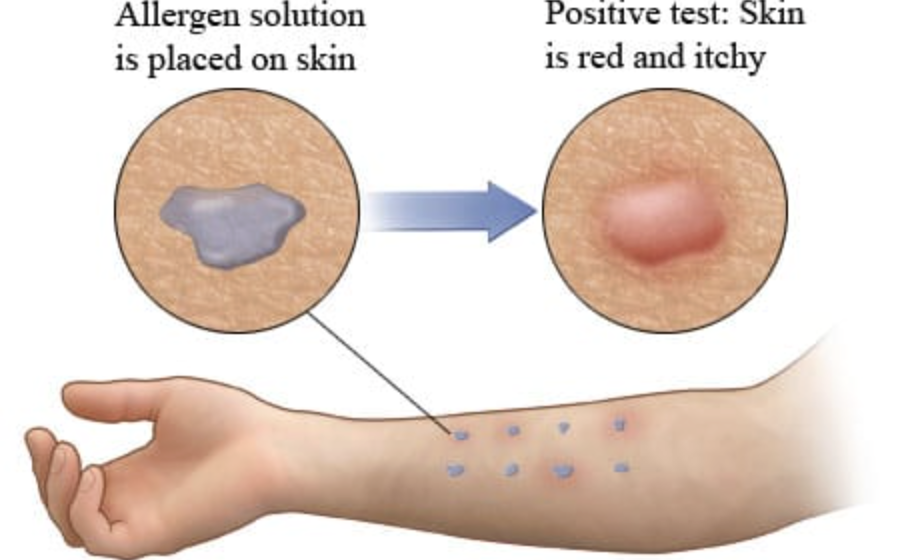
Like the name suggests, skin prick tests involve inserting a small amount of a substance into the skin by pricking it. After letting the substance sit for a couple of minutes, an elevated, red, itchy bump will either appear on the skin or it will look relatively the same. The substance that the skin is pricked with is called an allergen. An allergen is any substance that engenders an allergic reaction. Skin prick tests can test a wide variety of allergens from as many as 50. After cleaning the skin with a alcohol swab, a lancet will be used to prick the skin. After 20 minutes the reactions will be evaluated, and the bumps typically go away after a few hours. Skin prick tests elicit response from the immune system, which is composed of a complex network of lymphoid organs and cells like lymphocytes, that are responsible for protecting the human body against infection. When someone is allergic to a subtance, their body would have already produce a type of antibody called immunoglobulin E (IgE) to protect the body. These antibodies are produced by white blood cells called B cells. During the skin prick test, it the person is allergic to an substance the allergen will bind to IgE antibodies which are already binded to mast cells and basophils. Mast cells are on the skin while basophils are in the blood, but they are both essenitally two types of immune cells. This binding will trigger the production of histamine. Histamine, is responsible for the physical symptoms of allergic reactions. Histamine induces physical changes: blood vessels widening and becoming porous, fluid escaping blood vessels (responsible for redness and swelling), production of mucus ( esponsible for congestion, runny nose, and teary eyes), stipulated nerve endings ( responsible for itching, rash, or hives), and the production of more stomach acid.
Blood Tests:
Blood tests are another common type of allergy test administered. However, unlike skin prick tests, blood tests do not give instant results. Rather, the lab takes days to analyze the blood. Some people are unable to get skin prick tests if they have certain skin conditions or if they take antihistamines. Instead, they get blood tests. Allergy blood tests measure the amount of IgE in your blood. There are two types of allergy blood tests: a total IgE test and a specific IgE test. A total IgE test measures the total amount of IGE in your blood, while a specific IgE measures how much IgE your body produces as a reaction to a specific allergen. Like any other blood test, a healthcare professional will draw a small amount of blood into a test tube. If a specific IgE test was ordered more than one test tube may be needed. In terms of results a high total IgE test indicates that you have some sort of an allergy to something, but does not specifiy to what or how serious the allergy is. A high specific IgE test indicates that you may be allergic to the allergen that was tested, but once again does not indicate how serious the allergy is.
Takeaway:
Allergy testing plays a key role in pinpointing the cause of an individual’s allergy symptoms. Whether it is through a skin prick test or through a blood sample, both tests help doctors provide an adequate treatment plan. Understanding the differences between both types of allergy tests is vital to help comprehend why one may have been recommended for you!
Works Cited
“Allergies and the Immune System.” Hopkinsmedicine.org, 23 May 2024, www.hopkinsmedicine.org/health/conditions-and-diseases/allergies-and-the-immune-system? Accessed 7 Dec. 2025.
Cleveland Clinic. “Allergy Testing: What It Is, Indications & Types.” Cleveland Clinic, 2021, my.clevelandclinic.org/health/diagnostics/21495-allergy-testing.
Mayo Clinic. “Allergy Skin Tests – Mayo Clinic.” Mayoclinic.org, 26 Mar. 2024, www.mayoclinic.org/tests-procedures/allergy-tests/about/pac-20392895.
MedlinePlus. “Allergy Blood Test: MedlinePlus Lab Test Information.” Medlineplus.gov, 2017, medlineplus.gov/lab-tests/allergy-blood-test/.
“Skin Prick Test: Accuracy, How It Works, and More.” Healthline, www.healthline.com/health/allergies/skin-prick-test-accuracy#allergies.