
The Importance of Sunscreen
Hopefully, you guys are either tanning or enjoying an ice-cold glass of lemonade. Whatever it is, you’d better be making the most of the gorgeous spring weather. While saying this, however, I cannot put enough stress on why you need to wear sunscreen! The sun, although beautiful, emits something called short-wavelength light, known as ultraviolet light (UV), which can be harmful to the skin. Let’s get right into it!
Types of UV Rays:
In this context, there are two types of UV rays you should be aware of: UVA light and UVB light. The main difference between these two is that UVA has longer wavelengths and can even penetrate the Earth’s surface. The shorter of the two is UVB light. But what does this mean for your skin? Since UVA rays are longer, they can penetrate through the outermost layer of your skin, the epidermis, and the deepest layer, called the dermis. The epidermis is responsible for the look of the skin, while the dermis contains collagen and elastin, which are responsible for skin tightness. By disrupting this, damage from UVA is linked to wrinkles and even skin cancer. On the other hand, UVB rays are the main culprit of skin cancer and sunburns. They only penetrate through the epidermis and manage to stimulate photoaging (premature aging of the skin) and develop precancerous cells called actinic keratosis.
How UV Rays Cause Skin Cancer:
There are three types of skin cancer that involve three types of cells: basal cells, squamous cells, and melanocytes. Cancers involving the melanocytes are the most deadly; they are formed in the melanocyte cells themselves (cells responsible for melanin production). The other two have the lowest fatality rate. Basal cell carcinoma forms in your basal cells located in the lower part of your epidermis. Squamous cell carcinoma forms in your squamous cells in the outer layer of your skin.
The leading cause of basal cell and squamous cell carcinoma is DNA mutations in the p53 gene. The p53 gene is responsible for controlling cell death and DNA repair. When damaged, this gene fails to control damaged cells, which can allow for the growth of cancerous cells. The way this works is when UV rays penetrate through the skin, they break the chemical bonds between adjacent pyrimidine bases. Pyrimidine bases are essential to the structure of DNA and RNA, and the main bases are thymine (T), uracil (U), and cytosine (C). Usually, the chemical bonds that are broken on the DNA strand are where two cytosines are. As a result, the two broken bonds are linked together, which is called a pyrimidine dimer. When forming DNA, the unaffected strand produces regular DNA. However, the strand containing the pyrimidine dinucleotide matches the affected cytosines with adenines instead of guanines. When this faulty DNA is then replicated, it creates a mutation by pairing the pyrimidine dimer with adenines. When this mutation occurs in a gene like p53, which is responsible for regulating cancer, it makes the gene prone to cancer. To put it into perspective, Jan Pontén of Uppsala University Hospital in Sweden discovered in a study that 90% of squamous cell carcinomas have a mutation in the p53 gene. Additionally, in a study done by The American Journal of Pathology, it was found that fifteen p53 mutations were found in 11 of the 24 basal cell carcinoma samples.
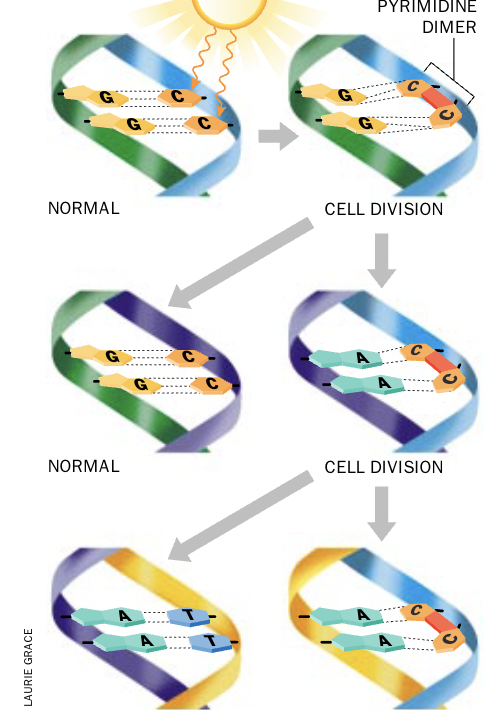
Here is a detailed visual to help you understand how the p53 gene mutation occurs.
Melanoma is, unfortunately, responsible for 80% of all skin cancer-related deaths. For melanoma, the leading cause is a mutation in the BRAF gene. The most common type of BRAF mutation is the BRAF V600E. As the name suggests, this mutation involves valine (V) and glutamic acid (E), which are amino acids—the building blocks of protein. In this mutation, the valine (V) is replaced by glutamic acid (E). The BRAF gene is responsible for regulating cell growth and division. So, when a mutation occurs, it can lead to uncontrollable cell growth, which can lead to cancer. In this context, we are only discussing melanoma; however, a mutation in the BRAF gene has close connections to acute myeloid leukemia, non-Hodgkin lymphoma, thyroid cancer, ovarian cancer, lung adenocarcinoma, colorectal cancer, and even some brain cancers.
How Sunscreen Works:
After discussing the above, it is imperative we discuss the value of sunscreen and how it works. To put it simply, sunscreen acts like a mirror for your skin. Sunscreen contains minerals like zinc oxide and titanium dioxide, which reflect the UV rays from your skin. However, it is important to remember that different sunscreens have different SPF (sunburn protection factor). Typically, an SPF 15 sunscreen blocks approximately 95% of UV rays, an SPF 30 blocks 96.7% of UVB rays, and an SPF 50 stops around 98.3% of UVB rays. Keep in mind that there are still some rays penetrating the skin, which is how we get tan.
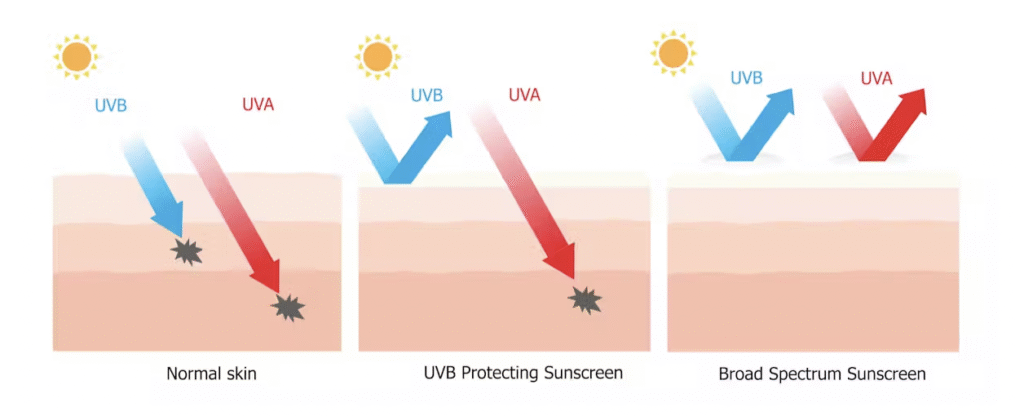
Look at how sunscreen works!
Works Cited
Cleveland Clinic. “Sun-Damaged Skin: Photoaging, Signs, Causes & Treatment.” Cleveland Clinic, 28 Oct. 2022, my.clevelandclinic.org/health/diseases/5240-sun-damage-protecting-yourself.
Johns Hopkins Medicine. “BRAF Mutation and Cancer.” Www.hopkinsmedicine.org, 2023, www.hopkinsmedicine.org/health/conditions-and-diseases/braf-mutation-and-cancer.
Leffell, David J., and Douglas E. Brash. “Sunlight and Skin Cancer.” Scientific American, vol.
275, no. 1, 1996, pp. 52–59. JSTOR, http://www.jstor.org/stable/24993269. Accessed 2
May 2025.
Zhang, Hong, et al. “Role of PTCH and P53 Genes in Early-Onset Basal Cell Carcinoma.” The American Journal of Pathology, vol. 158, no. 2, Feb. 2001, pp. 381–385, https://doi.org/10.1016/s0002-9440(10)63980-6. Accessed 20 Jan. 2025.