
Why Coral Bleaching Needs A Solution ASAP
Coral Bleaching might be a term you have heard. Yes, it is exactly what it sounds like, as coral bleaching is when corals begin to lose their color and are left looking pale and lifeless. Many credit coral bleaching simply to the rising temperatures, and while global warming is a main facet, there are many more. To put it officially, the National Library of Medicine says coral bleaching “represents the breakdown of a long co-evolutionary relationship between the coral host and its photosynthetic symbionts.” This may have just sounded like a whole lot of nothing, but trust me, after reading this article, you will understand!
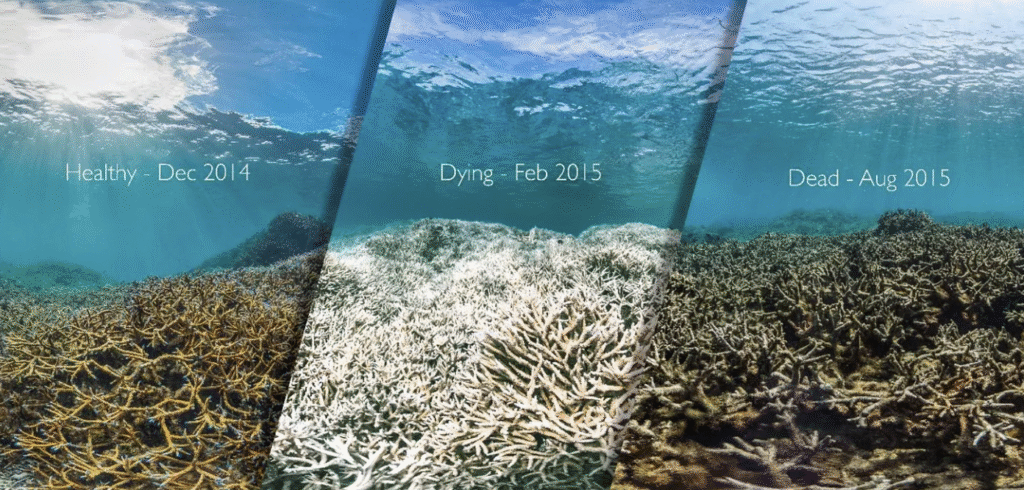
Look at the difference! It only takes a little bit for a corals health to decline.
How Corals Grow:
Corals have a symbiotic relationship with a type of single-celled organism called zooxanthellae. The corals provide the zooxanthellae with protection, produce carbon dioxide and water, which the zooxanthellae need for photosynthesis. On the other hand, the zooxanthellae turn carbon dioxide and water into oxygen with some help from the sun, and help remove waste from the coral. However, the most important part of their relationship is that through photosynthesis, the zooxanthellae provide the coral with building blocks of sugars and proteins, which are the products of photosynthesis. With these building blocks, the coral makes calcium carbonate, which is a key compound the coral uses to grow.
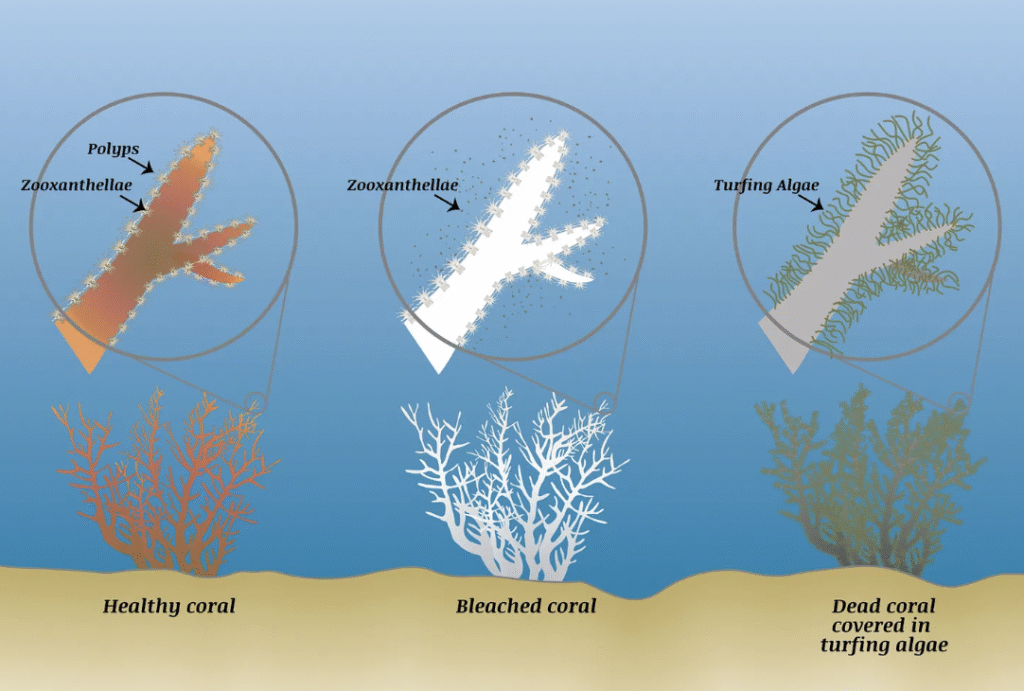
Here is a visual that may help you comprehend this better!
Coral Bleaching & Heat Stress:
Now that we have gotten the importance of zooxanthellae and how corals use them to grow, it is going to be way easier to learn the effect global warming has on coral reefs. As the world continues to grow warmer, unfortunately, so does the ocean. In fact, in the 1980s, the temperature of the oceans was only increasing by 0.06 degrees Celsius per decade. As of now, they are increasing at 0.27 degrees Celsius per decade. While this might not seem like a significant change, it has a drastic effect on coral reefs.
An abnormally warm temperature causes the zooplankton thermal stress. During this, the zooxanthellae’s photosynthesis machinery becomes damaged, which leads to an overproduction of reactive oxygen species (ROS). This then leaks into the coral cells, which bombards their antioxidant defense. To avoid damage that ROS can do, like structural changes in DNA and RNA, the coral releases the zooxanthellae, which ends their symbiotic relationship. Because of this absence, corals no longer have the key producer of the protein and sugar building blocks, which hinders their ability to produce calcium carbonate. Although the coral is still alive when it expels the zooxanthellae, it is extremely susceptible to disease, and without any other reserve energy sources, the coral can die. So not only has the coral lost its natural color, but it is extremely fragile now.
Coral Bleaching and Ocean Acidification:
Sadly, climate change isn’t the only thing contributing to coral bleaching. Another facet of this problem is ocean acidification. Acidification is the “absorption of pollutants from fossil fuel emissions, primarily carbon, into the ocean.” Oceans are huge absorbers of pollutants, and the world’s oceans absorb 30% of the world’s anthropogenic carbon dioxide. When the ocean absorbs pollutants, the pH of the ocean decreases, causing it to be more acidic. The pH of the ocean has experienced a 26% rise in acidity, as from pre-industrial times the ocean’s pH has dropped from 8.2 to 8.1. The reason why this pH change is an issue is that it decreases the amount of carbonate ions available for aquatic creatures and coral specifically. Remember when I explained how corals use calcium carbonate to grow? Well, without an adequate amount of carbonate ions, the coral cannot produce this compound. Therefore, corals cannot reach their required level of skeletal density.
How You Can Help:
Now that we have contextualized this problem, you are probably wondering what you can do to help save these beautiful creatures. The answer is simple! You need to reduce your carbon footprint! Make sustainable choices such as:
Recycle Properly!: Throw your trash away properly. Remember the three R’s–reduce, reuse, and recycle– as debris can be harmful to reefs. If you want to go above and beyond, participate in volunteering to pick up trash.
Environmentally Friendly Transportation: A regular passenger vehicle contributes around 4.6 metric tons of carbon dioxide emissions per year. To reduce this number, use sustainable methods of transportation like biking or taking advantage of public transportation. Electric and hybrid vehicles also tend to be more environmentally friendly (keep that in mind next time you buy a car).
Use Reef-Friendly Sunscreen While Visiting: Sunscreens tend to contain ingredients that can ruin coral reefs by altering their DNA. Check the ingredients of your sunscreen and make sure they dont contain: Oxybenzone, Octinoxate, Octocrylene, Homosalate, 4-methylbenzylidene camphor, PABA, Parabens, Triclosan, forms of microplastic, and any nanoparticles.
Works Cited
Nielsen, Daniel Aagren, et al. “Coral Bleaching from a Single Cell Perspective.” The ISME Journal, vol. 12, no. 6, 20 Feb. 2018, pp. 1558–1567, www.nature.com/articles/s41396-018-0080-6, https://doi.org/10.1038/s41396-018-0080-6.
—. “Coral Bleaching from a Single Cell Perspective.” The ISME Journal, vol. 12, no. 6, 20 Feb. 2018, pp. 1558–1567, www.nature.com/articles/s41396-018-0080-6, https://doi.org/10.1038/s41396-018-0080-6.
“Ocean Surface Warming Four Times Faster Now than Late 1980s – University of Reading.” Reading.ac.uk, 2025, www.reading.ac.uk/news/2025/Research-News/Ocean-surface-warming-four-times-faster-now-than-late-1980s.
van Woesik, Robert, et al. “Coral-Bleaching Responses to Climate Change across Biological Scales.” Global Change Biology, vol. 28, no. 14, 27 Apr. 2022, pp. 4229–4250, www.ncbi.nlm.nih.gov/pmc/articles/PMC9545801/, https://doi.org/10.1111/gcb.16192.
“What Is Coral Bleaching?” Blue Corner Marine Conservation, bluecornerconservation.org/coral-bleaching.
Noaa.gov, 2015, coralreefwatch.noaa.gov/satellite/analyses_guidance/global_coral_bleaching_2014-17_images/fig3_american-samoa_before-during-after_2015.jpg.