
What is Dengue?
Dengue Fever is an epidemic that has struck the world drastically. With no clear solution to prevent dengue, it is imperative to be well educated on the issue to take the proper precautions. As of 2015 there were around 50 million cases of dengue Fever worldwide. It may offer you some relief to know that only 0.5 million of these cases have progressed to the point of dengue hemorrhagic fever: a fatal form of dengue which entails severe bleeding, decrease in plasma, and potential organ damage. Those who live in subtropical areas are the most susceptible to dengue Fever because of the abundance of Aedes mosquitoes. In India alone, there were exactly 233,519 cases reported.
The Cause
Dengue Fever stems from four different virus stereotypes with different antigens (surface molecules): DENV-1, DENV-2, DENV-3, and DENV-4. These viruses are categorized as RNA viruses, meaning that the genetic information of the virus is stored in the form of RNA instead of DNA. This virus belongs to the same family, Flavivirus genus, as some other well-known viruses like yellow fever and the West Nile Virus. You might be wondering how dengue Fever spreads. Well, this is due to two types of Aedes mosquitoes: A. aegypti and A. albopictus. These mosquitoes are primarily from Asia, but they have spread to Africa, Europe, and the U.S. International travel and the transporting of goods between countries have exacerbated the spread of dengue.
Dengue is spread through the bite of an infected female mosquito of the Aedes genus. These mosquitoes are able to bite during the day and the night. Additionally, they feed on people both indoors and outdoors. After the mosquito bites a human with dengue, the virus will replicate in the midgut of the mosquito and then travel to the mosquito’s secondary tissues like the salivary glands. This makes the mosquito infected and able to transmit the virus. All together, this process takes around 8-12 days for the virus to spread from the human to the mosquitoes. Mosquitoes become infected as when a mosquito bites a human,and the blood of the human, which contains any viruses and parasites is also transferred to the mosquito. Thus, allowing the mosquito to spread to the next person through bites in their saliva.
In essence, the infected Aedes mosquito transmits dengue through its saliva in its bite to a human. This virus will then travel to the surface of the host’s cells, where it will bind to the receptors of the cells through its proteins. Once this process is enough, the DNA or in this case, the RNA of the virus, will invade and it will begin to reproduce in the cell. Once the virus is able to progress to the host cells before being stopped by the body’s immune system, infection begins.
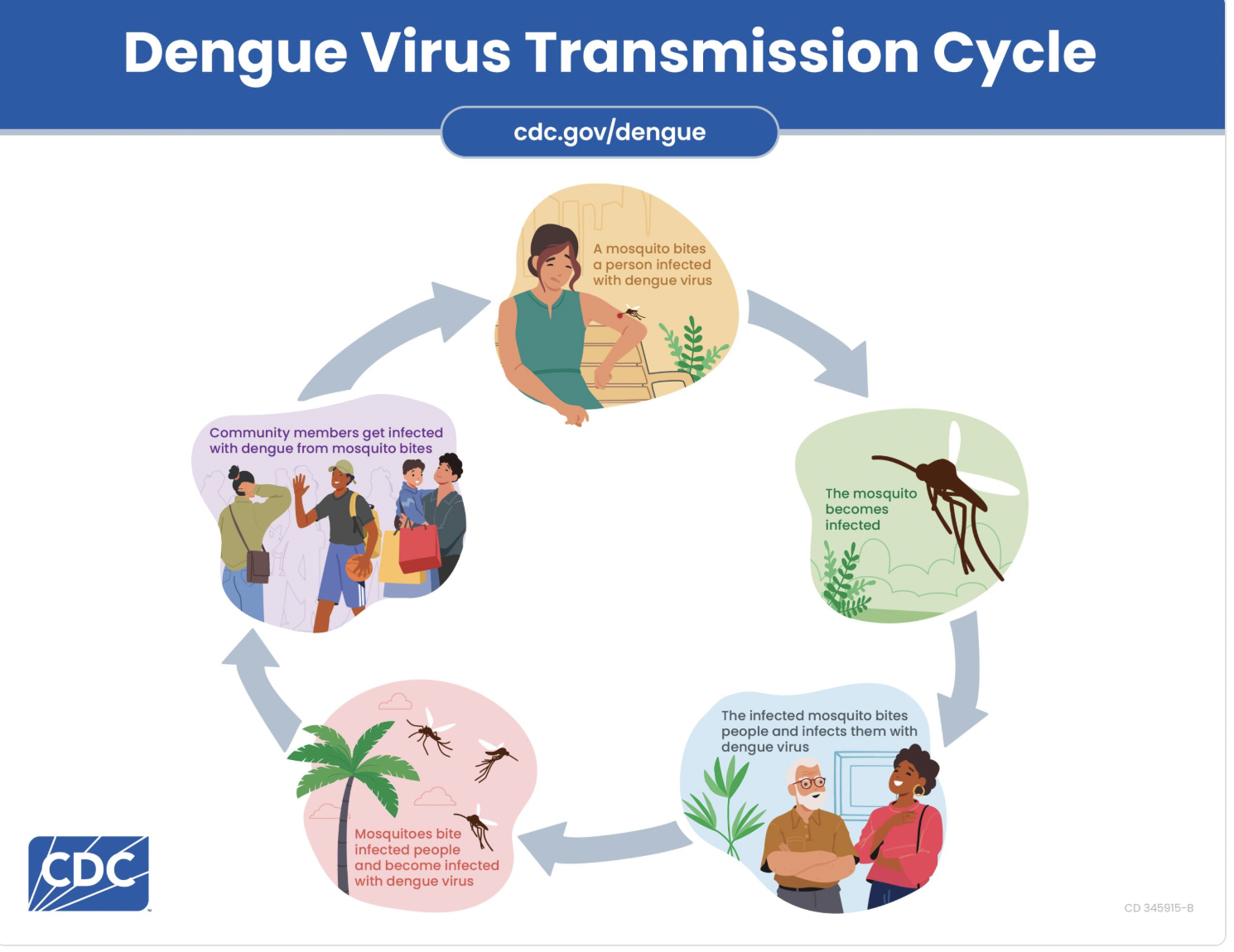
Notice how Dengue begins from a human to amosquito and spreads from mosquito to a human.
The Structure:
Through the help of electron micrographs it was revealed the size of the virus is around 500 Å or 50 nanometers. Dengue is made of a dense electron core surrounded by a lipid bilayer– a double layer of lipids–with a relatively smooth surface. As mentioned before, the dengue virus is a RNA virus, meaning it has a RNA genemone. This genome consists of approixmately 10,700 nucleotides. Additionally, dengue consists of three structural proteins. The first being in the core made of 100 amino acids: the building blocks of proteins. The second lives in the membrane with 75 amino acids. Finally, in the envelope—usally the outermost layer of a virus which proteins the genetic material–consits of 450 amino acids.
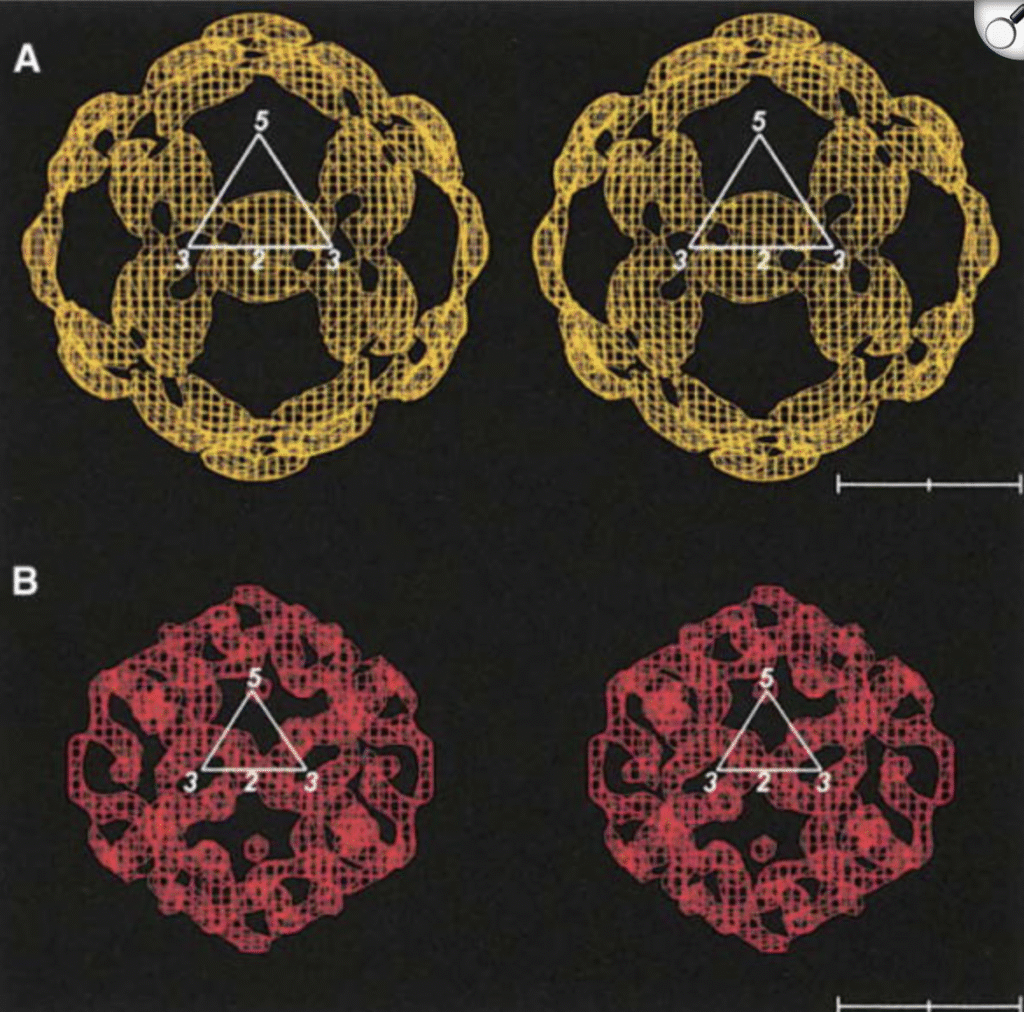
This picture shows the RNA core of the virus with a radius of around 105 Å.
Symptoms:
Febrile, critical, and convalescent are the three different phases of the dengue virus. The majority of patients reach the febrile phase but do not progress to severe forms like dengue hemorrhagic fever and dengue shock syndrome. The febrile phase consists of a sudden high-grade fever and dehydration, which usually lasts 2 to 7 days. Furthermore, the critical phase refers to when a patient begins bleeding, leaking plasma, or when a patient goes through shock and organ impairment. The convalescent phase refers to the recovery phase.
Dengue has an incubation period of around 3-14 days, but symptoms begin showing abruptly. Fever is a primary symptom of dengue with spikes at around 39.4-40.5°C. Pains and aches in the body, specifically arthralgia ( joint pain), myalgia (muscle pain), and bone pain, are the most common. Headaches can also indicate dengue, especially if they occur toward the front of the head. Patients with gastrointestinal symptoms usually have anorexia, nausea, vomiting, or pain in the central region of the abdomen. They also usually have a lack of appetite or taste sensation changes. Symptoms, like dizziness and weakness, usually align more strongly with patients who have dengue hemorrhagic fever. Patients usually begin to develop a rash enveloping the whole body 3-4 days after the fever after their skin begins to flush around the face, neck, and chest. Treatment:
There is no distinct cure for dengue; instead, doctors treat the symptoms of the patients with dengue in efforts to mitigate the virus. This consists of maintaining hydration, and in dengue hemorrhagic fever and dengue shock syndrome the treatments consist of fluid replacement therapy. Furthermore, to prevent further transmission of dengue, mosquito nets and coils are placed around patients. Fuerthmore, sources of stagnant water are removed to prevent mosquitos from breeding. Additionally, many are encouraged to wear clothing that covers exposed skins along with the use of insecticides, mosquito repellents, mosquito coils.
Death:
You are probably wondering that if dengue doesn’t seem to be that dangerous, how do some people die. This is primarily because of complications when dengue fever progresses severly. In some cases it can cause internal bleeding and in turn organ damage. Internal bleeding happens when blood vessels become to be damaged and work ineffectively. Furthermore, when the number of clot-forming cells–platelets–begin to decrease in the bloodstream, internal bleeding can happen. Platelets play a signifigant role in damaged blood vessels as they plug holes in the damaged vessels. Additionally pre-existing conditions play a huge role as well. To specify further, if a person had a history of cardiac disorders, renal transplants, diabetes, hypertension, or use anti-platelet drugs, they may be more susceptible to dengue.
Works Cited
Centers for Disease Control and Prevention. “How Dengue Spreads.” CDC, 26 Sept. 2019, www.cdc.gov/dengue/transmission/index.html.
Kuhn, Richard J., et al. “Structure of Dengue Virus.” Cell, vol. 108, no. 5, Mar. 2002, pp. 717–725, https://doi.org/10.1016/s0092-8674(02)00660-8.
Kularatne, Senanayake A M. “Dengue Fever.” BMJ: British Medical Journal, vol. 351, 2015, www.jstor.org/stable/26521869.
Saloman, Laurie. “How Do Viruses Make Us Sick? | Pfizer.” Pfizer.com, 2020, www.pfizer.com/news/articles/how_do_viruses_make_us_sick.
World Health Organization. “Dengue and Severe Dengue.” World Health Organization, 23 Apr. 2024, www.who.int/news-room/fact-sheets/detail/dengue-and-severe-dengue.