
Does Caffeine Actually Create Energy?
I’m sure we have all seen the “America runs on Dunkin” slogan, but do we actually? The truth is, while Americans may not rely on Dunkin specifically for their caffeine source, they certainly do enjoy coffee. In fact, 66% of U.S. adults drink coffee every day according to the 2025 National Coffee Data Trends Report, with the average consumer drinking 3 cups of coffee per day. In the 2024 Coffee Statistics: Consumption, Preferences, & Spending survey conducted by Syrcuruse Unvieristy, 67% of repsonsdents noted they drank coffee because they liked the energy it provided. With the majority of American adults drinking coffee, you must wonder if teens do the same. As a teen girl, I can say with confidence that I spend most nights doing my homework with a cup of coffee or an energy drink. Most teens can relate, as according to Michigan Medicine 1 in 4 parents report the teen having caffeine every day, with most parents reporting their teens drink coffee to stay awake during the school day. In sum, clearly caffeine is key facet of American culture, but does it really give provide you with a boost of energy or do you just feel more energized? We will find out in this article!
Sleep and Fatigue:
Caffeine is usually drunk when someone is feeling fatigued, which the National Cancer Institute defines as “ An extreme sense of tiredness and lack of energy that can interfere with a person’s usual daily activities”. A person who feels fatigued may have trouble concentrating or feel weak. Fatigue can result from many factors, but in the context of this article fatigue is closely related to an inadequate amount of sleep or poor sleep quality. Sleep is primarily controlled by two systems: Circadian rhythm and sleep-wake homeostasis. Caffeine mostly affects the sleep-wake homeostasis system, which keeps track of your body’s need for sleep. This system reminds your body to sleep after a certain amount of time and regulates the intensity of your sleep. In general, every hour you are awake more than usual, your sleep drive increases and the intensity of your sleep will as well. This is all mainly regulated by adenosine, a neurotransmitter which promotes your sleep drive. In general, adenosine stores and releases energy in the body. Namely, adenosine triphosphate (ATP) is broken down when the body needs energy for functions such as muscle contraction or the transmission of a brain signal. In this process, adenosine is released as a byproduct. Since the brain consumes the most ATP compared to other parts of the body, as the brain breaks down ATP, a significant amount of adenosine accumulated in the space between cells. Scientists claim that if you are awake for too long the adenosine build up begins to restrict activity in the brain related to wakefulness, which increases the body’s need for sleep, leaving you feeling tired.
Caffeine and Adenosine:
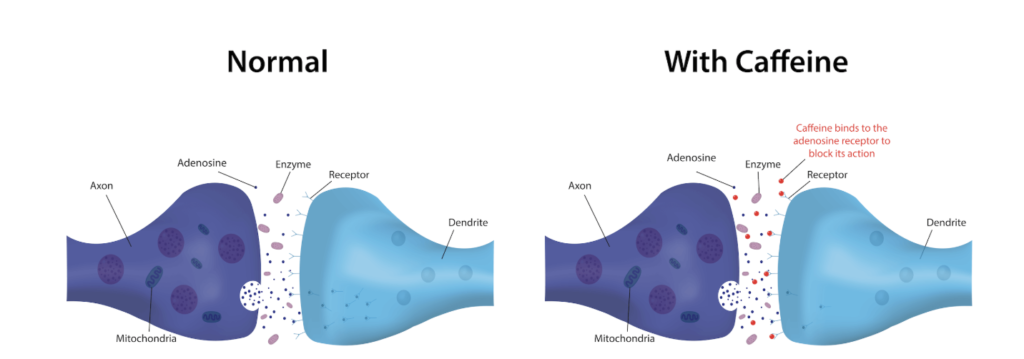
They way caffeine works in the body is directly linked to adenosine. Since caffeine is water and fat -soluble it is able to easily cross the blood-brain barrier in the brain and antagonize all four adenosine receptors (A1, A2a, A2b, and A3). To put it simply this means, caffeine binds to an adenosine receptor to limit its activity. Caffeine’s affinity for the A2a receptor is primarily responsible for caffeine’s sleeplessness effect. Like mentioned before adenosine plays a key role in regulating the body’s sleep drive. While scientists are still navigating how caffeine antagonizing adenosine translates into wakefulness, they hypothesize that it is because of the release of a neurotransmitter called Gamma-aminobutyric acid (GABA). Adenosine elicits GABA release, which inhibits the neurons responsible for wakefulness. Since caffeine restricts adenosine’s activity, it in turn opposes this action. This ultimately promotes wakefulness. So to answer the question posed before, caffeine does not increase the energy in your body. Rather it masks fatigue.
The Big Picture:
After reading this article you might be wondering what the big picture is. Well for starters, the effects of caffeine are temporary. Therefore, caffeine cannot replace the need for sleep as it cannot provide actual cognitive recovery. Furthermore, drinking too much caffeine can have detrimental effects on your sleep schedule. Many people do not know that caffeine has a half life of 5-6 hours. This means that it takes 5-6 hours for the concentration of caffeine to be reduced by half of its original concentration. This half life does not account for factors like weight, body max, age, genetic factors, and sex of a person. Caffeine also has almost 100% oral bioavailability, meaning that nearly all of it is absorbed into the bloodstream in its unchanged, active form. Additionally, caffeine is rapidly distributed in the brain. All of these components prolong the effects of caffeine, which makes your body feel like it does not need sleep, when it really does. This can ultimately impact your sleep schedule. This is why the FDA recommends drinking less than 400 milligrams of caffeine per day for most adults. However, doctors note that if you begin to get jittery, then you are drinking too much caffeine. Additionally be mindful of the time you drink coffee. Like I mentioned before, caffeine has a long half life so it is best to avoid drinking it late at night.
Works Cited
Cadwalader, Zac. “Americans Are Coffee Obsessed, and Not Just because of Caffeine.” Sprudge Coffee, Sprudge, 26 Jan. 2024, sprudge.com/americans-are-coffee-obsessed-and-not-just-because-of-caffeine-231276.html.
Evans, Justin, et al. “Caffeine.” National Library of Medicine, StatPearls Publishing, 29 May 2024, www.ncbi.nlm.nih.gov/books/NBK519490/.
Hajjar, George. “Coffee: America’s Most Popular Beverage – the Food Institute.” The Food Institute, May 2025, foodinstitute.com/focus/coffee-americas-most-popular-beverage/.
Mostafavi, Beata. “Does Your Teen Consume Too Much Caffeine? | Michigan Medicine.” Www.michiganmedicine.org, 20 May 2024, www.michiganmedicine.org/health-lab/does-your-teen-consume-too-much-caffeine.
National Cancer Institute. “Https://Www.cancer.gov/Publications/Dictionaries/Cancer-Terms/Def/Fatigue.” Www.cancer.gov, 2 Feb. 2011, www.cancer.gov/publications/dictionaries/cancer-terms/def/fatigue.
National Institute of Neurological Disorders and Stroke. “Brain Basics: Understanding Sleep.” National Institute of Neurological Disorders and Stroke, 5 Sept. 2024, www.ninds.nih.gov/health-information/public-education/brain-basics/brain-basics-understanding-sleep.
Summer, Jay. “Adenosine and Sleep.” Sleep Foundation, 7 June 2022, www.sleepfoundation.org/how-sleep-works/adenosine-and-sleep.
U.S. Food and Drug Administration. “Spilling the Beans: How Much Caffeine Is Too Much?” U.S. Food and Drug Administration, 28 Aug. 2024, www.fda.gov/consumers/consumer-updates/spilling-beans-how-much-caffeine-too-much.