
After being a part of various medical camps, it was clear that dental issues seemed to dominate the camps. Whether it be in Ghaziabad or Noida, compared to the lines for general physicians or ophthalmologists, the line for the dentist was always the longest. The Shree Parashvanath Digambar Jain Dharmarth Chikitsalaya Camp in Ghaziabad welcomed a variety of socioeconomic groups. In this camp equipped by experienced Medanta doctors and facilities, it was clear that dental issues were still a concern. In this camp, a middle-aged man came in. Despite being told by the dentist at the camp that his teeth were severely damaged due to his persistent use of tobacco, he refused to give it up, even when coupons for dental cleaning were offered. This highlights how lifestyle changes are the root of the issue, as medical assistance was available. A common misconception is that pyorrhea can only happen to a select few. But the harsh reality is that this is a recurring incident. For example, in Cleo County, a wealthy community, multiple elderly patients were coming in with stains on their teeth and plaque buildup simply from neglecting dental care. Furthermore, in a camp in Supertech Eco Village, I noticed that 60% of the patients had calcium deposits or tartar. What was more concerning was that the majority of patients were suffering from brownish-yellow stains on their teeth. However, the most alarming thing I witnessed was that patients ranging from as young as five were suffering as many as 5 cavities. You may think of it to be a minor injury in your mouth, but cavities, tartar, and a lack of oral hygiene make you susceptible to pyorrhea. I’ve concluded that poor dental hygiene goes beyond economic and social boundaries. The common link between all of the Medanta Camps was chronic neglect of the teeth. In my point of view, this stems from a lack of awareness regarding the consequences of poor dental care. This mindset must change because pyorrhea is easily preventable.
`
Pyorrhea–a chronic disease–primarily stems from poor dental hygiene, such as irregular brushing of the teeth and flossing. Also known as periodontitis, pyorrhea is a more severe form of gingivitis: initial inflammation of the gums. To put it simply, pyorrhea is inflammation of the periodontal structures rather than just the gingiva, like in gingivitis. Essentially, this results in a severe decrease in the connective tissue attachment in teeth. Pyorrhea is best categorized as bacterial and occurs when an overload of bacteria accumulates in the mouth. This bacteria, along with leftover food particles and saliva, form a sticky yellow film layer known as plaque. When this plaque hardens, it is known as tartar. Tartar, plaque, and food debris all contribute to the inflammation of the gums.
Initially, pyorrhea begins as a tiny portion of irritated gum tissue. There is only a slight color change in the tissue along with a lesion: damaged or abnormal tissue. When the lesion slowly becomes more irritated by plaque, tartar, or food debris, venous blood and gingival hypertrophy–an abnormal overgrowth of gingival tissue–is present. Furthermore, the gums appear red, swollen, and tender when touched. As pyorrhea progresses to the advanced stage, the tissue becomes damaged near the apex of the tooth: the tip of the root of the tooth. Here, the connection between the alveolar process, gum tissue, and periodontal membrane becomes loose. Eventually, pus will begin to form, which contributes to the loosening of the teeth. Periodontal pockets may also begin to form, which is a space between the gum and the tooth.
Symptoms:
In order to spot pyorrhea, perhaps it is best to understand what healthy gums look like at first. Healthy gums are pink and firm and do not bleed while brushing or flossing. On the other hand, gums suffering from pyorrhea have the following symptoms: swollen and red gums, tender gums, bad breath that doesn’t subside, sensitivity to hot and cold foods, receding gums, and pus between the gums and teeth.
Thoughts from an Expert:
After interviewing Dr. Kamal Agrawal, a dental surgeon and consultant prosthodontist, I was able to gain more insight into this topic. When asked why pyorrhea is so common in certain areas, the dentist replied that it is mostly common in third-world countries where literacy rates are low. In the context of India, there is a lack of oral hygiene, as many are unwilling to brush their teeth. This mindset needs to evolve as Dr. Agrawal claims the consequences of pyorrhea are “bleeding gums, foul smell in the mouth, teeth sensitivity, teeth loss, and teeth removal”.While this does seem frightening, there is a simple solution, which Dr. Agrawal claims is “maintenance of proper hygiene,” which includes brushing your teeth after the last meal and flossing. If you are suffering from pyorrhea, there is no need to fret, as it “can be treated by a qualifying dentist”. The doctor notes that on average, the treatment is around 3000 INR; however, government facilities may offer free treatment. According to Dr. Agrawal, there are two treatment options: surgical and non-surgical. Surgical treatment involves the removal of the periodontal pockets. In comparison, non-surgical treatment entails supra-gingival or sub-gingival cleaning, depending on the case. This is usually done by an ultrasonic machine or manually.
Works Cited
Agrawal , Kamal . Pyorrhea: Thoughts from an Expert. 10 July 2025.
“EBSCO Sign In.” Ebsco.com, Funk & Wagnalls New World Encyclopedia, 2025, research.ebsco.com/c/n4jhak/viewer/html/a4zisndalj. Accessed 10 July 2025.
Flemmig, Thomas F. “Periodontitis.” Annals of Periodontology, vol. 4, no. 1, Dec. 1999, pp. 32–37, https://doi.org/10.1902/annals.1999.4.1.32.
Pujari, Venkateswar. “Journal of Advanced Medical and Dental Sciences Research.” Journal of Advanced Medical and Dental Sciences Research, vol. 7, no. 9, Sept. 2019, https://doi.org/10.21276/jamdsr.
“Pyorrhea Types, Causes, Symptoms (1).” SlideShare, Slideshare, 2025, www.slideshare.net/slideshow/pyorrhea-types-causes-symptoms-1/251206854#2. Accessed 10 July 2025.
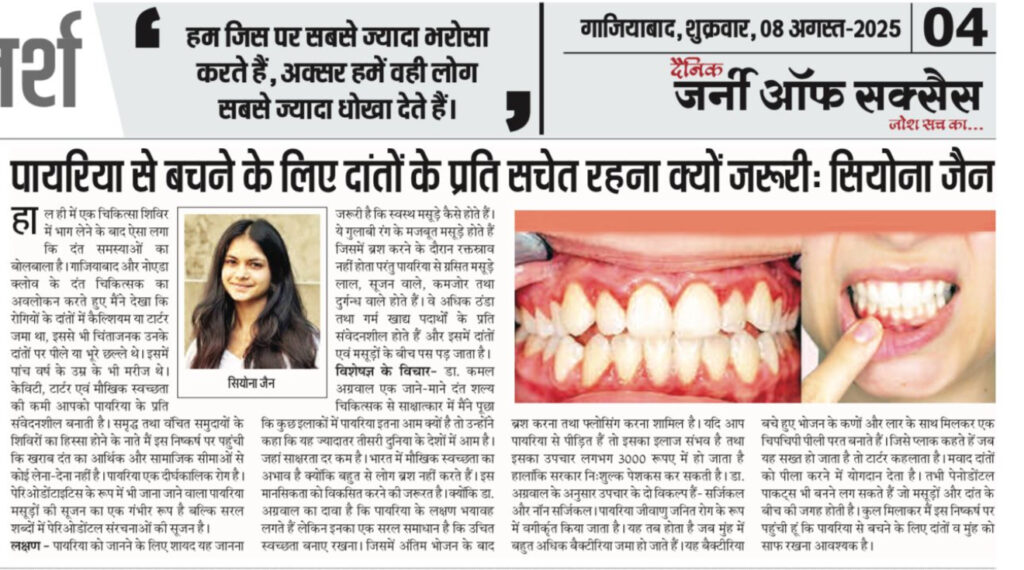
A pdf from one of the seven newspapers my article was published in!