
Signs of a Stroke: FAST
Every 40 seconds in the United States, someone has a stroke. Every 3 minutes and 14 seconds someone in the United States dies from a stroke. These statistics clearly indicate how common strokes are in the U.S. Therefore, knowing how to identify a stroke to ensure someone can access treatment is imperative and should be common knowledge. This is of particular importance to strokes because early action can increase chances of survival. Hopefully after reading this article you will understand all the early signs of stroke that could be helpful in preventing times of crisis!
What Are Strokes:
Before we delve into signs of strokes, you should first learn exactly what strokes are! A stroke is a condition where blood flow to the brain is blocked or when there is sudden bleeding of the brain. There are two types of strokes: ischemic and hemorrhagic. Approximately 90% of strokes are ischemic. This involves when blood flow to the brain is blocked from a blocked or narrowed blood vessel. This depletes the brain of essential nutrients such as oxygen. Without circulation, brain cells began to die in minutes. Causes of this include blood clots that travel to the brain from the body, usually the heart or when fatty deposits clog the blood vessels. On the other hand, hemorrhagic strokes involve sudden bleeding in the brain which causes pressure on brain cells. This pressure damages the brain cells. Hemorrhagic strokes can stem from a variety of factors: high blood pressure, overuse of blood thinners, aneurysms, head trauma, cerebral amyloid angiopathy, and even ischemic strokes. Strokes can lead to both permanent and temporary disabilities, and in serious cases, death. These effects can range from paralysis, behavioral changes, memory loss and cognitive issues, trouble eating or swallowing, and pain.
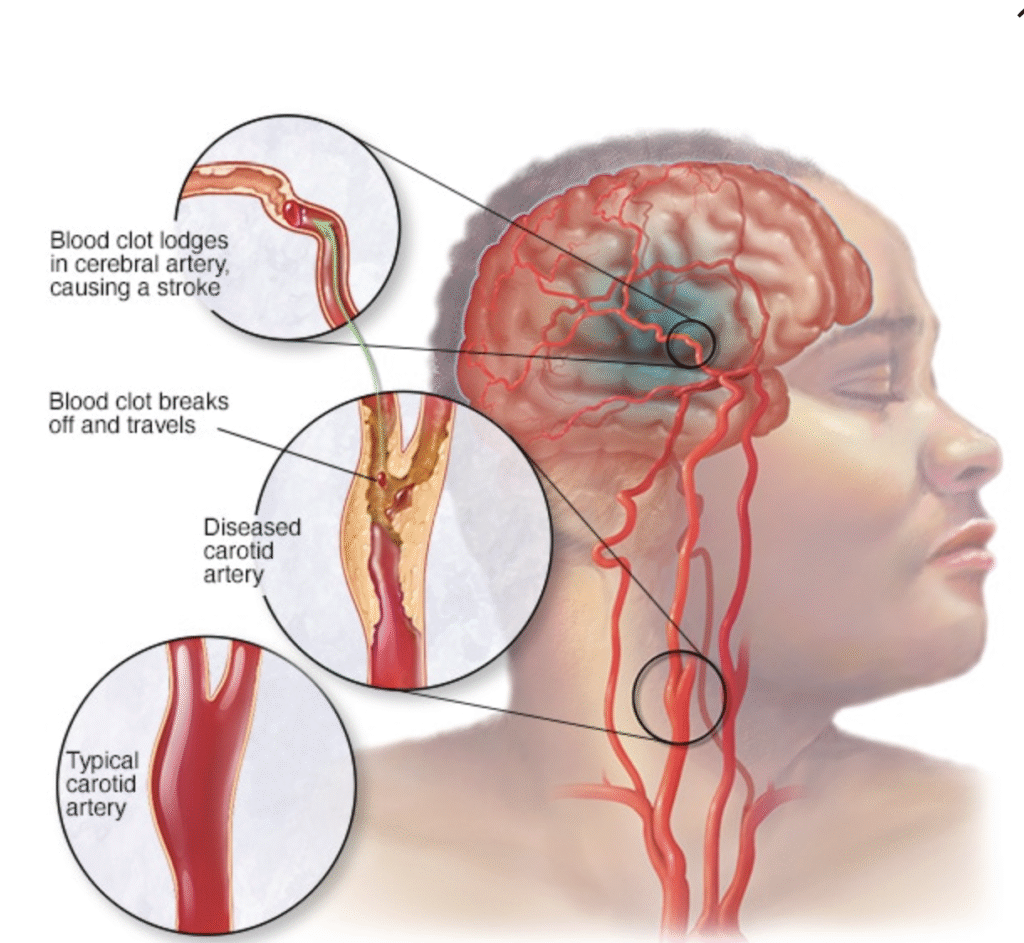
Here is a visual to understand ischemic strokes!
Symptoms of Strokes:
Symptoms of strokes are extremely important, and it is important to keep track of when symptoms begin as they can affect the type and efficiency of treatment given. A symptom of stroke includes trouble speaking and confusion understanding what others are saying. For example, someone experiencing a stroke may appear confused by slurring words and failing to understand speech. Another symptom is numbness, weakness, or paralysis in the face, arm, or leg. In strokes, numbness,weakness, or paralysis often occurs on one side of the body. To test if this is happening try asking the person to raise both of their arms over their head. If you notice one hand beginning to drop it could be a sign of a stroke. Another indicator is a droop when trying to smile. Vision issues are another symptom. If the person has blurred,blackened vision or is seeing doubles they may be having a stroke. A sudden and severe headache may also be a symptom of stroke. As a result of a headache a person may experience vomiting, a loss of consciousness, or dizziness. Another symptom is trouble walking. For example a person may lose coordination and stumble or lose balance.
Identifying a Stroke:
If you think someone may be having a stroke, think of the acronym F.A.S.T. F stands for face drooping. Ask the following questions to yourself “Does one side of the face droop or is it numb? Ask the person to smile. Is the person’s smile uneven?” The A stands for arm weakness. Ask yourself the following questions “ Is one arm weak or numb? Ask the person to raise both arms. Does one arm drift downward?” The S stands for speech difficulty. Ask yourself the following questions “Is speech slurred” The T stands for Time to Call 911. If you think someone is dealing with a stroke, call 911 immediately and keep track of when the symptoms started.
Works Cited
American Stroke Association. “Stroke Symptoms.” Www.stroke.org, American Stroke Association, 2024, www.stroke.org/en/about-stroke/stroke-symptoms.
“Stroke Symptoms.” Www.stroke.org, American Stroke Association, 2024, www.stroke.org/en/about-stroke/stroke-symptoms.
Brown, Robert. “Stroke.” Mayo Clinic, 2024, www.mayoclinic.org/diseases-conditions/stroke/symptoms-causes/syc-20350113.
Centers for Disease Control and Prevention. “Stroke Facts.” Stroke, CDC, 24 Oct. 2024, www.cdc.gov/stroke/data-research/facts-stats/index.html.
National Heart, Lung and Blood Institute. “Stroke – What Is a Stroke?” Www.nhlbi.nih.gov, 26 May 2023, www.nhlbi.nih.gov/health/stroke.